How Bill Gates aims to clean up the planet
How Bill Gates aims to clean up the planet
It’s a simple idea: strip CO2 from the air and use it to produce carbon-neutral fuel. But can it work on an industrial scale?
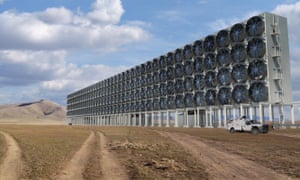
It’s nothing much to look at, but the tangle of pipes, pumps, tanks, reactors, chimneys and ducts on a messy industrial estate outside the logging town of Squamish in western Canada could just provide the fix to stop the world tipping into runaway climate change and substitute dwindling supplies of conventional fuel.
It could also make Harvard superstar physicist David Keith, Microsoft co-founder Bill Gates and oil sands magnate Norman Murray Edwards more money than they could ever dream of.
The idea is grandiose yet simple: decarbonise the global economy by extracting global-warming carbon dioxide (CO2) straight from the air, using arrays of giant fans and patented chemical whizzery; and then use the gas to make clean, carbon-neutral synthetic diesel and petrol to drive the world’s ships, planes and trucks.
The hope is that the combination of direct air capture (DAC), water electrolysis and fuels synthesis used to produce liquid hydrocarbon fuels can be made to work at a global scale, for little more than it costs to extract and sell fossil fuel today. This would revolutionise the world’s transport industry, which emits nearly one-third of total climate-changing emissions. It would be the equivalent of mechanising photosynthesis.
The individual technologies may not be new, but their combination at an industrial scale would be groundbreaking. Carbon Engineering, the company set up in 2009 by leading geoengineer Keith, with money from Gates and Murray, has constructed a prototype plant, installed large fans, and has been extracting around one tonne of pure CO2 every day for a year. At present it is released back into the air.
But Carbon Engineering (CE) has just passed another milestone. Working with California energy company Greyrock, it has now begun directly synthesising a mixture of petrol and diesel, using only CO2 captured from the air and hydrogen split from water with clean electricity – a process they call Air to Fuels (A2F).

Comments
Post a Comment